
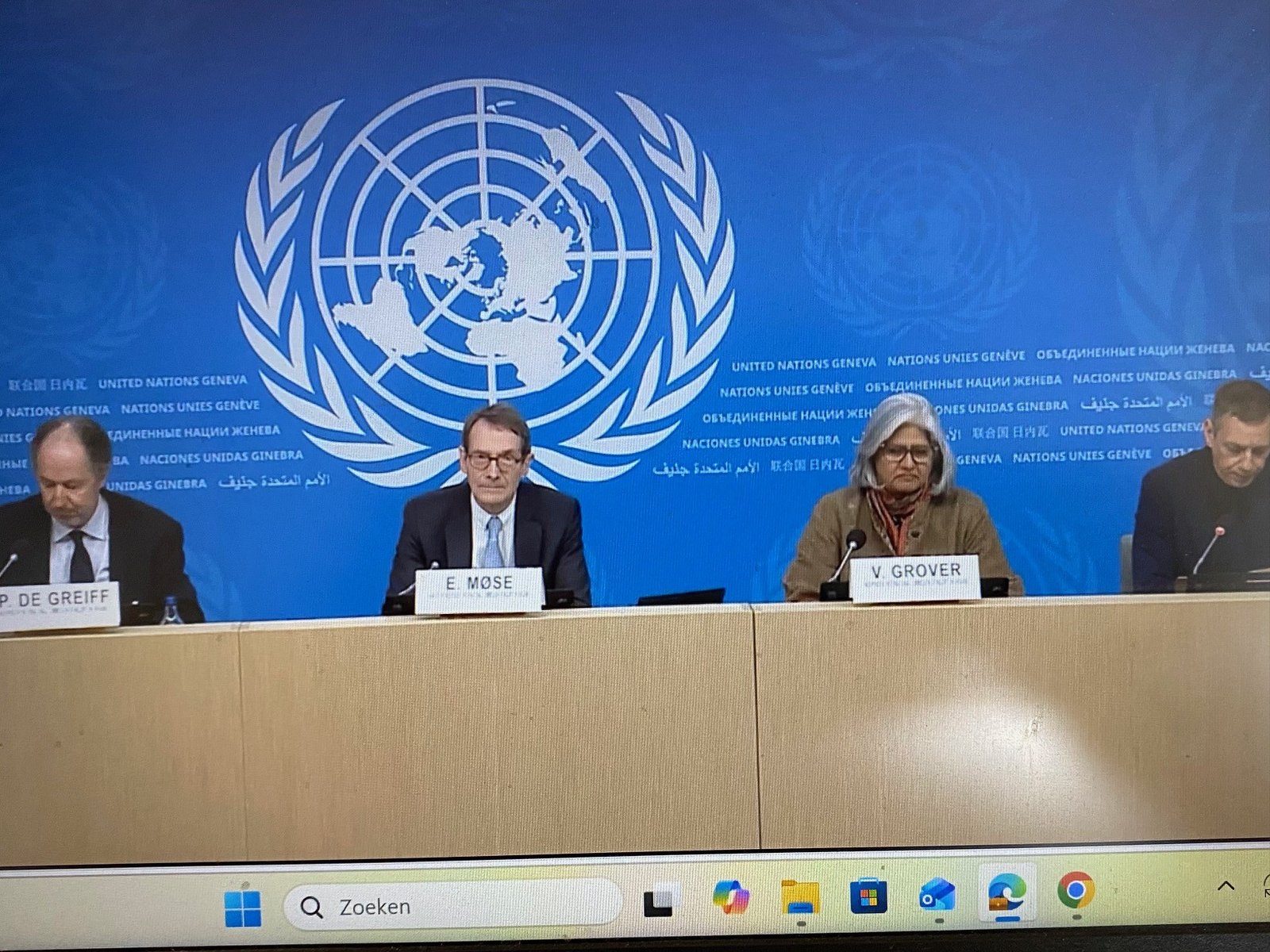
In the current report, the Independent International Commission of Inquiry on Ukraine presents its latest findings on crimes and violations committed during the Russian Federation’s full-scale invasion of Ukraine.
The Commission has continued its investigations concerning the deportation or transfer of children by Russian authorities to the Russian Federation or to areas they occupied in Ukraine. Compelling evidence concerning the deportation and transfer of a total of 1205 children from five oblasts in Ukraine, verified by the Commission, has led it to conclude that these acts amount to crimes against humanity and war crimes of deportation and forcible transfer of children.
The Russian authorities have systematically failed to disclose the whereabouts of the children to parents or legal guardians and have kept them in a coercive environment obstructing their return. Instead of establishing a system facilitating the return of the children, the authorities have sought their long-term placement with families or in institutions in the Russian Federation. Throughout 2022, Russian authorities declared that adoption was their preferred option for the placement of these children. The Commission has therefore also concluded that Russian authorities have committed the crime against humanity of enforced disappearance of the children deported or transferred from Ukraine, and the war crime of unjustifiable delay in their repatriation.
From the cases investigated by the Commission, 80 per cent of the children have not yet returned. Those who managed to organize returns encountered obstacles, delays, and security risks. Many parents and legal guardians remain unaware of the fate and whereabouts of the children and are still searching for them. Children suffered from trauma and anxiety. A child who managed to return to Ukraine, stated, “I was sad, I was scared. I worried that I would have to live in the Russian Federation”.
The Commission has also investigated the conduct of trials by courts in the Russian Federation and in Russian occupied areas of Ukraine. Civilians and prisoners of war from Ukraine were mainly charged with terrorism, espionage, and violent seizure of power. The Commission found that these courts have deprived the accused from fundamental fair trial guarantees and have therefore committed grave breaches of international humanitarian law, which constitute war crimes.
Russian authorities have systematically used evidence that they fabricated or obtained by means of torture or ill-treatment to incriminate the accused. The courts have disregarded the fair trial guarantees concerning the presumption of innocence, the non-retroactivity of laws, the right not to be compelled to confess guilt, the right to public proceedings, and the right to defence. The evidence of the Commission points to a lack of independence and impartiality of the courts, with pre-determined verdicts and the guilt of the accused assumed from the outset.
Further, the Commission has investigated the circumstances of nationals from 17 countries recruited to fight with the Russian armed forces in Ukraine. Many had been deceived and lured from abroad through promises of civilian employment or other lucrative arrangements. They were coerced to sign contracts written in Russian, which they did not understand, and assigned dangerous tasks on the frontlines.
The Commission has in addition interviewed 85 soldiers who had served in the Russian armed forces in connection with the hostilities in Ukraine and since deserted. Most of them testified about violent practices used by commanders against soldiers. These included shooting on the spot, beating, detaining in a pit, tying to a tree, as a punishment for refusing to participate in military assaults that would lead to certain death or for withdrawing from the frontline when injured or lacking supplies. The accounts demonstrate a total disregard for human life and dignity and suggest that the use of violence against subordinates is widespread and systematic within the Russian armed forces.
As for Ukraine, the Commission recalled that that the overbroad definition of the crime of “collaborative activities” in the Ukrainian criminal code has led to prevailing legal uncertainty. It highlighted that activities that do not endanger national security may also be interpreted as falling within the scope of the crime. On analysing rulings of the Supreme Court of Ukraine on this issue, the Commission found that when delineating activities considered lawful, the Supreme Court failed to consider applicable international humanitarian law, which obliges the Occupying Power to ensure that essential services in territories under their control continue to be provided to the civilian population.
Finally, the Commission documented violations reported during mobilisation for the Ukrainian armed forces. These include irregular administrative detention, lack of access to a lawyer, and hurried examinations by military medical commissions that ignore possible underlying medical issues. Instances of violence have been recorded against conscientious objectors, who were taken by force to recruitment centres and military bases, regardless of expressed readiness to carry out alternative civil service.
Author: UN Independent Commission of Inquiry on Ukraine
A/HRC/61/61
Advance unedited version
Distr.: General
9 March 2026
Original: English
For the full report see:
Photo: online press conference which was attended by May-May Meijer