To many, the war in Sudan feels like a sudden escalation, but those familiar with recent history saw the signs emerging long before. What is unfolding today is the result of years of power struggles, political fragmentation, and international interests.
A fragile transition following Bashir’s downfall
Following the ousting of President Omar al-Bashir in 2019, Sudan appeared to be heading in a new direction. A transitional government was formed under the leadership of Abdalla Hamdok, in which civilians and the military worked together towards a democratic future.
However, that cooperation proved fragile. Behind the scenes, the old power structure remained largely intact. Figures within the army, including Abdel Fattah al-Burhan, had already held key positions under Bashir and retained their influence. At the same time, the power of the paramilitary Rapid Support Forces (RSF), led by Mohamed Hamdan Dagalo, better known as Hemedti, which had emerged from the notorious Janjaweed militias, grew.
Tensions between these two power blocs escalated, particularly following the military coup of October 2021, which ousted the civilian government. From that point on, the likelihood of a violent confrontation was virtually inevitable.
International interests and rivalry
The internal power struggle in Sudan was exacerbated by foreign interests. The army sought closer ties with Egypt, partly due to shared security interests and geopolitical tensions surrounding the Nile. At the same time, Hemedti built relationships with the United Arab Emirates and the Russian Wagner Group, including through gold trade and military cooperation.
This external support gave both sides not only resources but also the confidence to strengthen their positions. What began as a political power struggle thus turned into an armed conflict with international dimensions.
War breaks out
In April 2023, the situation escalated completely: the Sudanese army and the RSF came into open confrontation. Since then, violence has spread across large parts of the country. What was initially a struggle between two military factions threatens to escalate into a wider civil war, with all the consequences that entails for the region.
A humanitarian crisis of enormous proportions
Whilst those in power fight, it is the population that pays the highest price. The humanitarian situation in Sudan is now among the most serious in the world.
Millions of people are fleeing, both within the country and to neighboring countries such as Chad, South Sudan, and Egypt. Refugee camps are becoming overcrowded and basic services are failing.
At the same time, the food supply is collapsing. Due to the violence, agriculture has largely ground to a halt and supply routes have been disrupted. For millions of people, this means acute food insecurity, with a real risk of famine in some areas.
Healthcare has also been severely affected. Hospitals have been destroyed or are no longer functioning due to a lack of staff, medicines, and electricity. In these circumstances, diseases such as cholera and malaria are running rampant, further exacerbating the crisis.
A sustainable solution therefore begins with ending external support for the warring parties in Sudan
The war in Sudan illustrates just how fragile a political transition can be when old power structures persist and external interests come into play. What began as a hope for democracy has turned into a conflict with no quick resolution. As long as the warring parties continue to cling to power, and international actors continue to pursue their own interests, an end to the violence seems a long way off. Meanwhile, the humanitarian disaster continues to deepen — with consequences that affect not only Sudan, but also the region and beyond.
At the same time, this tragedy makes one thing painfully clear: without external intervention, this conflict will not come to an end of its own accord. As long as regional and international actors continue to provide the warring parties with support, resources, and political cover, they are indirectly perpetuating the violence. Countries such as Saudi Arabia, Egypt, the United Arab Emirates, Eritrea, and Ethiopia bear a particular responsibility in this regard.
A sustainable solution therefore begins with the cessation of this external support. Only when these countries jointly exert pressure on both the army and the RSF will there be scope for genuine negotiations. This means: enforcing an immediate ceasefire and compelling both parties to take their seats at the negotiating table. Without this international pressure, peace remains an abstract ideal; with this pressure, it can become the first step towards stability, recovery, and, ultimately, a future in which the Sudanese people no longer pay the price for a struggle for power.
Ahmed Abushaam
Ahmed Abushaam is an opinion columnist, an expert on the Middle East and Sudan, and a financial expert within the non-profit sector. He was born on 2 November 1975 in Khartoum (Sudan) and has lived in The Hague since 2005. He is the father of two children and works as a financial controller at a social organization.
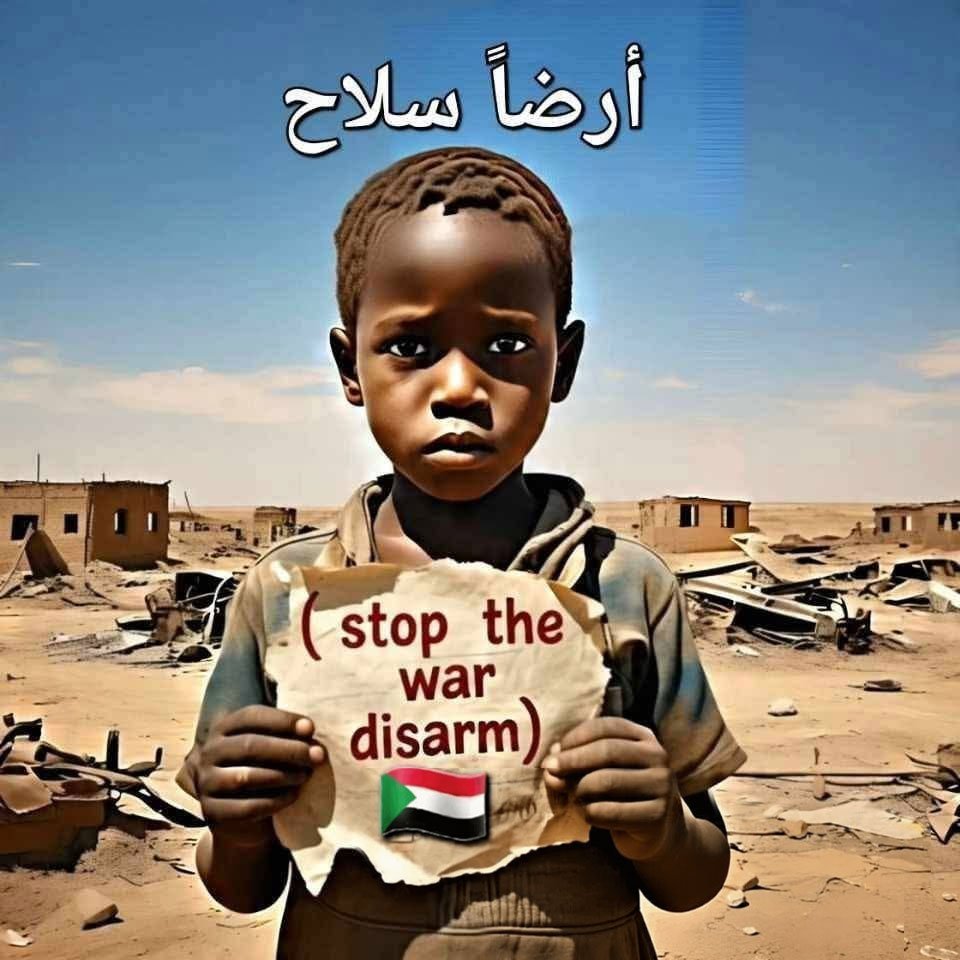
Photo: A child in Sudan calling to lay down arms. This AI image was used in the beginning of the war in Sudan according to Ahmed. Creator: unknown.