
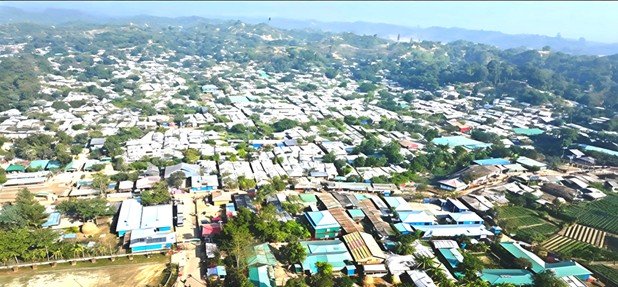
I am a Rohingya and I live in the world’s largest Rohingya refugee camp in Cox’s Bazar.
Cox’s Bazar is the district of Bangladesh where 32 Rohingya refugee camps are located and is known as the world’s largest Rohingya refugee camp. Cox’s Bazar is a hilly and crowded place where more than one million Rohingya people shelter in camps. It is a huge daily struggle to survive with safety and dignity inside the camps. More than one million Rohingya people live in these crowded places, many having fled from Myanmar when the violence became unbearable. The largest wave occurred in 2017, though people are still arriving in smaller groups. We left behind our burning houses, villages, gunfire in the dark, family members who never made it across the border. The memories stay with us. Many wake in the middle of the night, hearts racing, convinced the screams are real again. We lie there in the dark, listening to rain dripping on plastic or wind rattling the sheets, trying to convince ourselves we are safe now. The shelters are made of bamboo and plastic tarpaulin, close to one another. In the monsoon season, rain comes through the holes and falls onto sleeping mats. The floor turns into mud, causing big landslides in the monsoon season. Children, men and women have died during the landslides. We have to face fire incidents in every winter season. We cannot sleep peacefully because we are afraid that fire will break out. A small fire for cooking, a candle falling, or a gas stove can start a fire. When a fire starts, it spreads very quickly. Many shelters burn down in just a few minutes. People stand and watch as everything we own is lost again. After the fire, we look through the ashes to find anything left. The next day, we look for help from NGOs, INGOs and individuals with kind hearts. We, the Rohingya people, can rebuild new shelters, eat food, wear clothes, etc. if we gain help and support from NGOs and others.
The learning facilities are very limited in the Rohingya refugee camps in Cox’s Bazar. Formal education is largely denied to Rohingya students. There are no proper schools, no recognized certificates, and no clear paths forward. Higher education is almost completely out of reach. Rohingya youth who once dreamed of becoming doctors, engineers, or teachers, etc. now face a tough truth: their future has no door to knock on. Even the most talented students are stuck, watching their years slip away without qualification or recognition. Following recent funding cuts, the situation has grown much worse in the camps. Many learning centers have completely or partially shut down. So now thousands of young Rohingya students miss out on education. Doors that were once open to children are now locked. The silence left behind is heavy. Rohingya students are receiving quality education through community-based learning centers with qualified teachers teaching the curriculum of our own country, Myanmar.
Overcrowded shelters, poor sanitation, and contaminated water cause sickness and disease, especially among children and the elderly. Clinics exist, but they are overcrowded, understaffed, and often short of medicine. People wait for hours, and many return home without proper treatment. Chronic illnesses, maternal health needs, and mental health issues are difficult to manage in the camps. Trauma from violence and displacement remains untreated for many. Recent funding cuts have forced health facilities to reduce services or shut down, making an already fragile system even weaker. For the Rohingya, healthcare is not about comfort, it is about dignity and survival. When access to health care disappears, suffering grows quietly, and lives are put at risk every day. Women and girls face many extra hardships in the camps. Most have no income and depend fully on aid to survive. They manage the household, care for children, and collect water every day under constant pressure. Many feel unsafe, especially at night. Some experience harassment or violence but remain silent because speaking out can put them in more danger. Their strength keeps families going, yet their struggles remain mostly unseen. One of the biggest challenges in the camp is not knowing the future. Going back to Myanmar is not safe and life in the camp cannot last forever. Young people want to work, learn skills, and help their families but chances are very few. Living year after year without clear answers slowly takes away hope.
There are many things I hope for. I hope for a future where my people can live with dignity, safety, and equal rights in our homeland. I hope for peace, justice, and opportunities for Rohingya children to enjoy higher education, and to dream without fear and extend the community-based schools run by REAL.
On a personal level, I hope to continue my work in supporting my community and to see real change, even if it takes time. And I also hope for simple things such as good health, meaningful relationships, and moments of happiness. And I also strongly hope that our organization REAL will grow and become influential.
Author: Maung Myint Swe, founder of “Rohingya Education And Advocacy League” (REAL), Cox’s Bazar, Bangladesh
Note: This blog was originally written by the author. Some use of AI tools was made to support language refinement.
Photo: By the author (Maung)