
In my previous opinion piece, I discussed how the heatwave in Europe at the end of June is estimated to have claimed 20,000 lives, according to a report in Dutch national newspaper De Volkskrant on 7 July. The article was written by Maarten Keulemans. He quotes climate scientist Christopher Calahan (Indiana University), who published the calculations online. In June, the highest number of fatalities appears to have occurred in Spain, France and, notably, in Germany and Hungary. In the Netherlands, an additional 360 people died as a result of the heat.
I wrote that the Netherlands had not taken any measures following the floods in Limburg in 2021. In a reaction on the Joop website, ‘Jozias2’ rightly pointed out to me – via a link to a central government website – that the Netherlands is, in fact, taking action. On the central government website, I read: “The government presents a Climate Plan every five years. This plan sets out how the government will work towards becoming climate-neutral by 2050 over the next ten years. The Climate Plan 2025–2035 states, amongst other things, that the government considers a 90 per cent reduction in greenhouse gas emissions by 2040 to be a logical intermediate step.”
According to the RIVM, greenhouse gas emissions in the Netherlands in 2025 were 0.8 per cent higher than in 2024. Last year, greenhouse gas emissions were 36 per cent lower than in 1990. The Climate Act stipulates that greenhouse gas emissions in 2030 must be 55 per cent lower than in 1990. This amounts to a reduction of 125 megatons of CO₂ equivalent. Between 1990 and 2024, emissions fell by an average of 2.4 megatons per year. In 2025, emissions were 1.2 megatons higher than in 2024. To meet the target set out in the Climate Act, emissions must fall by an average of 8.7 megatons per year over the next five years.
The point is, however, that greenhouse gas emissions are still rising, according to Professor Mike Berners-Lee during a National Emergency Briefing in the United Kingdom. I assume he is referring to global emissions. See, for example, the report ‘GHG emissions of all world countries’: https://edgar.jrc.ec.europa.eu/report_2025.
“Since the beginning of the 21st century, global greenhouse gas (GHG) emissions had followed an upward trend mainly due to the increase in emissions from China and the other emerging economies. As a result, the atmospheric concentrations of greenhouse gases substantially increased, enhancing the natural greenhouse effect, which may negatively affect life on Earth…
China, the United States, India, the EU27, Russia, and Indonesia were the world’s largest GHG emitters in 2024. Together they account for 51.4% of the global population.”
The world is warmer than it has been for at least the last 100,000 years – and not only is the rate of warming higher than ever before in history, but that rate is also accelerating. The Earth is truly in uncharted territory, according to Johan Rockström, director of the PIK – Potsdam Institute for Climate Impact Research.
Europe is the fastest-warming continent, according to the EU’s Copernicus Climate Change Service. Temperatures there have been rising twice as fast as the global average since the 1980s. 2025 was the third warmest year on record globally. Europe experienced several intense heatwaves, and this is also the case this year.
In France, a massive wildfire is currently raging south-east of Paris. According to the French Minister of the Interior, Nuñez, 32,000 hectares of forest have been destroyed by fire in France since the start of the summer season. “That is already more than the entire 2025 season,” the Minister of the Interior stated on the Dutch news website NOS on 13 July. “We are expecting a very difficult season,” he added. Yesterday, 250 fires were recorded in France, including around thirty “critical” ones.
According to climate scientist Johan Rockström, climate change is leading to more extreme events, including more heatwaves, wildfires, droughts, and floods. In short, Mother Earth is suffering greatly as a result of climate change and the decline of nature, as I also argued in my previous opinion piece…
So what we can learn from the countries around us?
In the United Kingdom, National Emergency Briefings have been introduced. These consist of leading national experts in the fields of climate and nature who explain to Members of Parliament where we currently stand, where we are heading and what we can still do. They are also calling for a televised ‘emergency briefing’.
See: https://www.youtube.com/playlist?list=PL6b0HBZ3v-IkuFdfsieHeQVvo2rDWoADE
We could also organize National Emergency Briefings in the Netherlands – and in other countries – led by leading experts in the fields of climate and nature. We could also broadcast an ‘emergency briefing’ on television.
Furthermore, a Chief Planetary Officer has recently been appointed in Belgium. Luc Bas, director of the Belgian CERAC (Climate Risk Assessment Centre), has been appointed Chief Planetary Officer, and further appointments in other countries are set to follow. Perhaps this is also an idea for the Netherlands?
In short, I hope that world leaders will unite against climate change and in support of nature conservation and combating biodiversity loss. May there be world peace, because human lives and nature must be cherished. ‘Peace is green’. Let us listen to indigenous peoples, scientists, and climate activists. May we look after one another and nature.
Hopefully, we will soon see: A World Where All Children Can Play.
PS Many thanks to Astrid Fischer, who lives in the United Kingdom, and drew my attention to the National Emergency Briefings.
Author: May-May Meijer
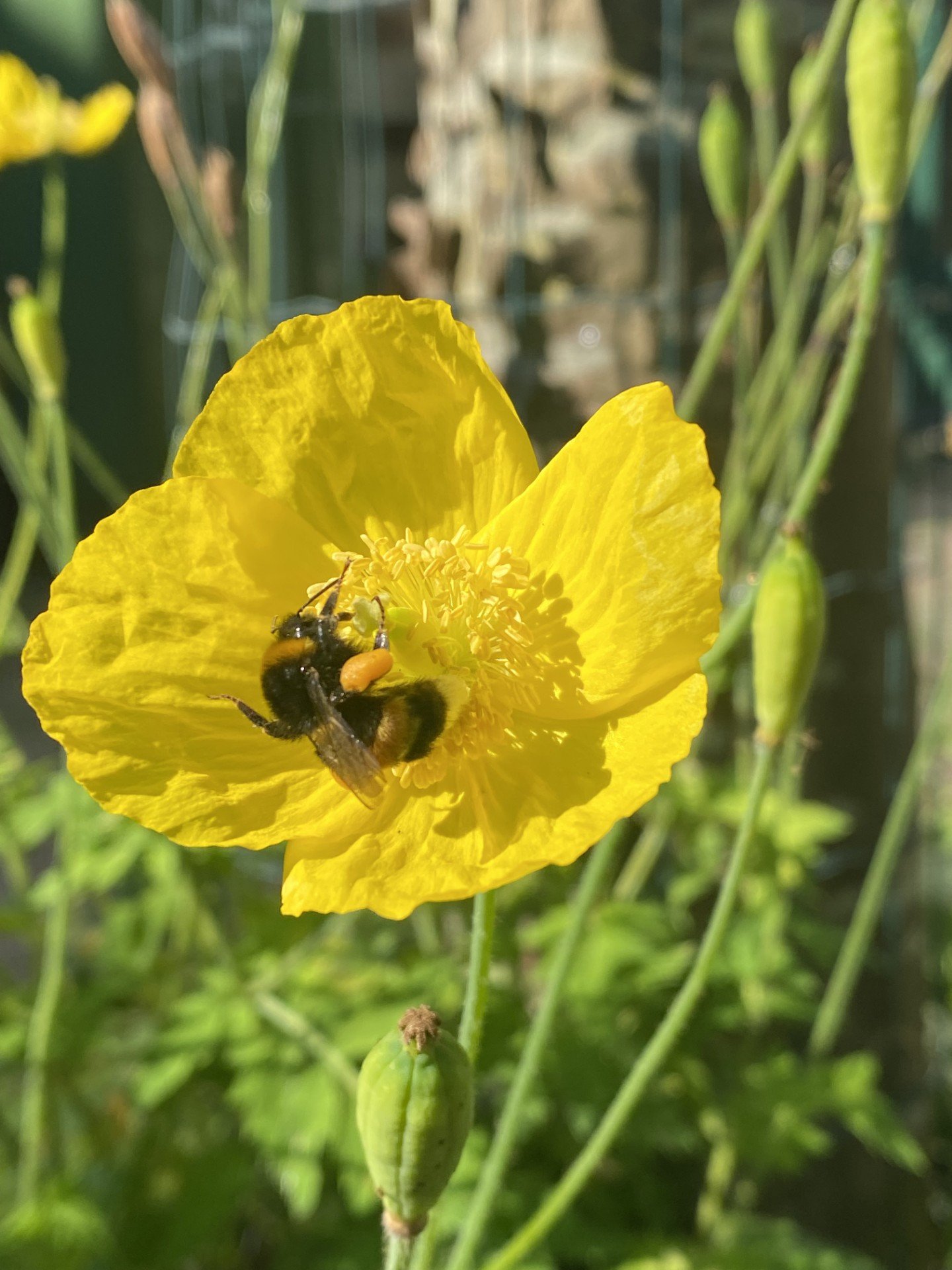
Photo: A flower and a bee. Photo by May-May Meijer, the Netherlands
Note: This article was first published in Dutch under the title: ‘Waar blijven de (inter)nationale crisiscomités tegen klimaatverandering en voor behoud van de natuur (vervolg)?’ on the Joop BNNVARA website on 11th July 2026.
Translated using DeepL.com (free version) and corrected by Kumar Jamdagni