Once again, people are being killed in Sudan, and once again the Darfur region is at the centre of the violence. The war in Sudan is usually described as a civil war between two rival generals. That description is not incorrect, but it is incomplete. It obscures the historical and international forces that made the conflict possible.
A small power elite with monopolies on natural resources is engaged in a struggle amongst themselves. Two warring generals are at the centre of this power struggle: Al-Burhan leads the Sudanese Armed Forces (SAF) and Dagalo the Rapid Support Force (RSF). Neither the SAF nor the RSF prioritises the protection of civilians. Since April 2023, more than 150,000 people have been killed, around 14 million displaced and nearly 30 million affected by hunger.
Every time there is a new wave of violence in Sudan, a predictable pattern emerges in Europe: a brief outcry, followed by silence. The war is then described as a complex struggle between two generals or as an internal Sudanese problem, far removed from our own concerns. This causes the historical and international dimensions of the conflict to fade from view. It is precisely this perspective that makes it possible to treat the war as a tragedy with which outsiders have little to do, whilst external powers have been playing a role in Sudan’s political and economic development for over a century.
The violence must not be reduced to a feud between two quarrelling generals… The causes are structural and historical, and Europe and the Arab world share the blame. Both should therefore become more actively involved in bringing the war to an end.
The Janjaweed militia in Darfur, deployed by al-Bashir and responsible for the genocide of the Masalit people in 2003, formed the basis for the current RSF. A key Janjaweed commander at that time was the current RSF leader, Dagalo. As early as 2003, the Janjaweed were using racist narratives in which non-Arab people were labelled as slaves. Sudan has a colour-coded system for this: if you are black, you are labelled a ‘slave’ – ‘abid’ in Arabic. If you are slightly lighter in colour, you are an Arab and a Muslim. The lines of conflict between groups that define themselves as Arab or non-Arab have continued to exist in Sudan since then.
The same terminology recurs in the RSF’s crimes of 2025. As recently as late January, Reuters reported on the enslavement of children by the RSF. It is a continuity that stretches far back into the colonial era. That continuity begins with the Ottoman-Egyptian conquest of present-day Sudan in the 1820s. Through that conquest, separate kingdoms and sultanates were for the first time formed into a coherent whole known as Sudan. The Egyptian conquerors exploited the gold reserves and intensified the slave trade. People from the periphery were particularly affected.
With the construction of the Suez Canal in 1869, Europe established its colonial and economic hegemony. When Egypt was weakened by financial difficulties, the British took control in 1882. As the Anglo-Egyptian Condominium, the British Empire effectively annexed Sudan as a colony. Roughly speaking, there were four ‘castes’: at the top, of course, the white British; below them the Egyptians; below them the ‘Arab tribes’; and the outcasts were the ‘African tribes’.
A second ‘divide and rule’ strategy was to draw clear dividing lines between the Islamic north and the Christian or animist south. Finally, the capital was heavily favoured over the periphery, for example Darfur, South Sudan or Kordofan. In this way, the British colonialists laid the foundations for the violence we see today.
Even after the colonial period, Sudan remained a pawn of regional and international powers. In the years around independence, both Egypt and Great Britain sought to influence the country’s political future. In doing so, they exploited existing religious, regional, and political divisions that had deepened during the colonial period. It thus became clear early on that the balance of power in Sudan was not determined solely by the Sudanese themselves, but also by rival foreign interests.
Even today, external players are intervening on a massive scale, particularly the Emirates. The United Arab Emirates (UAE) supports the RSF with high-tech drones and financial flows via intermediaries in the Horn of Africa. This comes as no surprise: the Emirates have strategic interests across the region, ranging from gold smuggling via RSF networks to a military presence on the Red Sea. What is less well known is how close those interests are to Europe. The EU has a substantial free trade relationship with the UAE. Dutch pension funds invest billions in Emirati sovereign wealth funds. Schiphol and Amsterdam are major hubs for Emirati airlines. The EU shies away from sanctions against Abu Dhabi for fear of damaging the energy relationship.
Meanwhile, the UAE is keen to present itself in the best possible light in Europe. The UAE is also making inroads in a completely different sphere: sport. Manchester City is financed by the Abu Dhabi United Group, owned by Sheikh Mansour, a member of the Emirati royal family. The same network that funds drones bound for Darfur also finances the stadium in Manchester viewed by millions of European fans every week. Sportswashing in its purest form: polishing a reputation through football, whilst the bill is paid elsewhere.
The UAE are not the only ones cheering on and fuelling the chaos in Sudan. Saudi Arabia supports the SAF. Russia has been active on both sides. China supplies weapons to both parties. The Quad Initiative (US, Saudi Arabia, UAE, and Egypt), which is supposed to bring about peace, consists of the very same countries that are funding the war. The EU is pumping in humanitarian aid but covers only eleven per cent of the need, for fear of deteriorating relations with Arab energy partners.
When reports of mass killings by the RSF in Darfur once again circulate around the world in the coming months, we must realise that this is not a civil war, but a conflict rooted in colonial history, from which countries far beyond Sudan are profiting. It shows little historical awareness and is also unwise to portray the war in Sudan as an internal conflict, far removed from us. As long as Europe considers its oil contracts to be more important than Darfur, our outrage is nothing but a charade.
This opinion piece by Jos Hummelen was previously published on the Dutch BNNVARA’s Joop website under the title: De oorlog in Soedan is geen burgeroorlog. Het is een business model.
Sudan is in the grip of apocalyptic conditions: war, ethnic cleansing, and famine. In our part of the world, the conflict is largely ignored. But Europe is deeply intertwined with the history of this crisis, according to Jos Hummelen, presenter of the Dutch-language podcast De Africast.
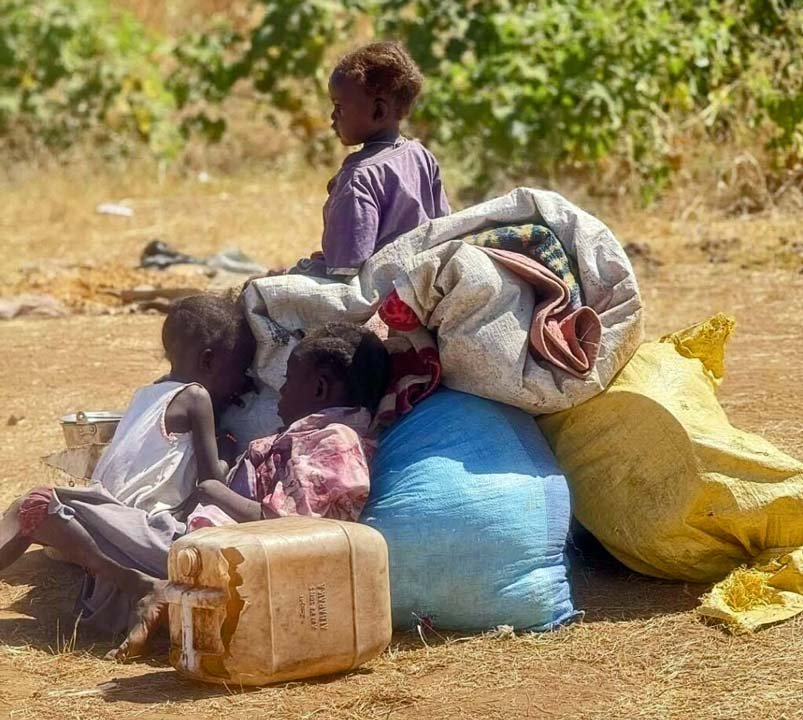
Photo: Desperation and devastation – exhausted children displaced from El Fasher rest en route to Tawila (Photo: Radio Dabanga correspondent)