
According to the Dutch meteorological institute KNMI, the Netherlands experienced a heatwave from 18 June to 29 June of this year. From 24 June, a code orange heat warning was in place for part of the country, and on 26 and 27 June, a code red warning was issued. This was the first time that the KNMI, in consultation with the Weather Impact Team (WIT), had issued a code red warning for heat. But the Netherlands wasn’t the only place feeling the heat. High temperatures were recorded in many parts of Europe. In several countries, temperature records were broken, sometimes for several days in a row. Research by World Weather (WWA), an international group of scientists of which the KNMI is a member, shows that these high temperatures across Europe would have been virtually impossible without climate change. “Heatwave at the end of June claimed an estimated 20,000 lives in Europe”, headlined Dutch national newspaper De Volkskrant on 7 July.
I was working from home on those days with my blinds down. However, because of the antipsychotic medication I’m taking, I tend to feel the heat quite easily. I recalled the floods in Limburg on 13 and 14 July 2021 caused by heavy rainfall. According to the KNMI, the heavy rainfall caused extensive damage in South Limburg, as well as in Belgium, Germany, Luxembourg and Switzerland. Homes were flooded, roads were cut off, rivers burst their banks and, in Germany, as many as 200 people lost their lives. The event was one of the five costliest disasters in Europe in the past half-century, with an estimated total damage of 32 billion euros.
At the time, I was surprised that nothing was being done to tackle climate change. But now, with this heatwave, I thought our own politicians wouldn’t be able to escape it. I was sure that national and international crisis committees would be set up to combat climate change and preserve nature. Just as was the case with the coronavirus. Although I should point out that I personally experienced that to be a (too) intense period. Since that time, I’ve stopped watching the Dutch news channel NOS, and only read the websites. I’ve also been spending even more time in nature.
To my surprise, however, everything remains the same. The Extinction Rebellion protesters are demonstrating as usual against tax breaks for companies such as Shell and Tata Steel – what they call ‘fossil fuel subsidies’ – and are being arrested. I had expected that they and climate scientists would at least be invited for talks by now. An Extinction Rebellion activist (named Kris-tofski Kriebelaar) points out in her Facebook post that scientists say we are in the midst of the sixth mass extinction.
According to the Dutch broadcasting company NPO, the Earth has been hit by five major waves of extinction over the past 550 million years, the last of which – the extinction of the dinosaurs – is the best known. We must take seriously the possibility that we are on the eve of a new wave of mass extinction, said journalist Marit de Jong on Dutch TV channel VPRO’s Tegenlicht program in April 2022. The world is facing a biodiversity crisis. Scientists warn that one in eight species is threatened with extinction, many within a matter of decades. And humans are the main cause. There have been very few, if any, extinctions over the past hundred years that would have occurred without human activity. We are destroying the habitats of animals and plants, overfishing the oceans, causing environmental damage, and contributing to rapid global warming. ‘If you look at the current loss of biodiversity, you see alarming figures,’ says Lars van den Hoek Ostende, a paleontologist and researcher at Naturalis. Species going extinct is, in principle, part of nature, but it is now happening a hundred times faster than normal.
As if this weren’t bad enough, The Guardian reported on 1 July this year that ocean surface temperatures had reached a record high in June. The oceans absorb more than 90 per cent of the excess energy in the Earth’s system, which is mainly caused by the burning of fossil fuels such as oil, coal and gas. The scientist John Abraham has calculated that in 2020, the amount of heat added to the oceans was equivalent to around five Hiroshima bombs per second. Last year, this figure was closer to 11 Hiroshima explosions per second.
There was also a major wildfire in Spain on the Costa Brava. Sander Otte, a professor of quantum physics and columnist, states on LinkedIn that this is due to the heat dome that has been hanging over Europe for weeks as a result of climate change. There are also dozens of wildfires in the south of France, a consequence of an exceptionally hot and dry June. The French authorities find it worrying that the wildfire season is already so intense. On Friday 3 July, Interior Minister Laurent Nuñez wrote that, as far as wildfires are concerned, France is a month ahead of schedule.
The Amazon is also nearing a tipping point. Floor Boon wrote in the Dutch quality newspaper NRC on 20 and 21 June that scientists are warning that large parts of the forest are approaching a tipping point beyond which the rainforest can no longer sustain itself. “If nothing changes within four to eight years, the destruction of the Amazon rainforest will be irreversible.” This statement was made by the Brazilian scientist Paulo Artaxo, professor of atmospheric physics at the University of São Paulo, in an interview with BBC News Brasil on 1 July 2019. In Floor Boon’s NRC article, Alessandra Korap, leader of the Munduruku people, states that mothers tell her that their breast milk is poisoning their own children. This is due to gold mining, which leaves deep scars on the landscape. Gold miners use mercury to extract gold particles from the sediment. A Greenpeace report shows that this toxic metal ends up in rivers, fish and, ultimately, in humans.
In short, I hope that world leaders will unite against climate change and in support of nature conservation and combating biodiversity loss. May there be world peace, because human lives and nature must be cherished. ‘Peace is green’. May the voices of indigenous peoples, scientists and climate activists be heard. May we look after one another and nature.
Hopefully, it will come soon: A World Where All Children Can Play.
Author: May-May Meijer, founder Peace SOS
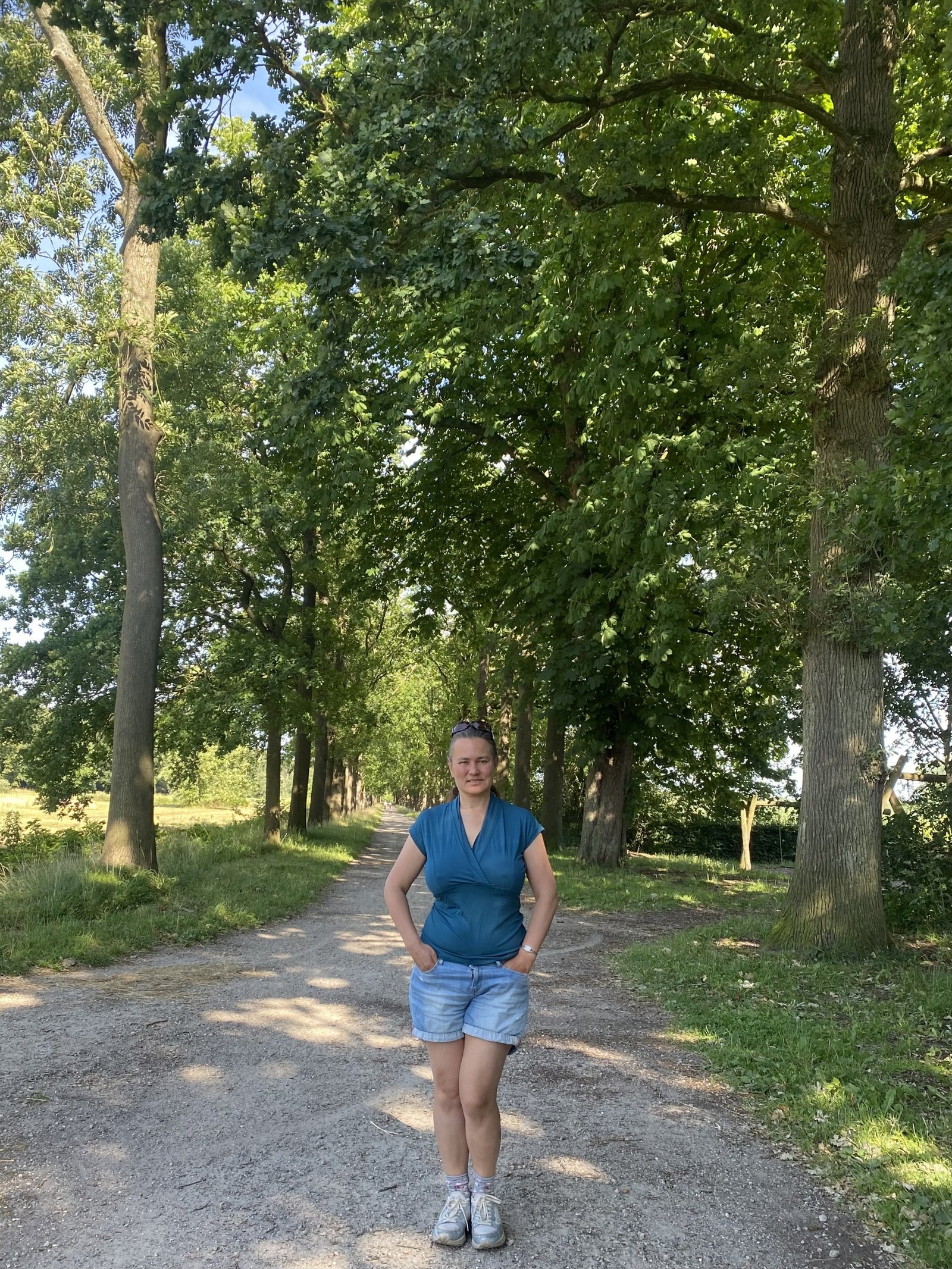
Photo: May-May Meijer in the Netherlands
Note: This article was first published in Dutch under the title: ‘Waar blijven de (inter)nationale crisiscomités tegen klimaatverandering en voor behoud van de natuur?’ on the Joop BNNVARA website on 7th July 2026.